Hogar
HogarPencil Case Buying Guide for School Supply Buyers
Define the student and contents first, confirm the usable size second, select the product structure
Pencil cases may look like simple school products, but different formats can serve very different users, capacities and market positions.
A flat zipper case may be suitable for a basic school program. A gusseted or box-shaped case can hold more stationery. A structured PP pencil box provides stronger shape retention, while a rectangular silicone pencil case offers a softer touch and a more distinctive retail appearance.
For importers, school-supply distributors, wholesalers and stationery brands, the correct choice should be based on the intended student, actual contents, usable dimensions, product structure, material and sales channel.
This guide provides a practical process for comparing pencil cases before sampling or bulk ordering.
Choose the pencil case in this order:
Define the student and contents first, confirm the usable size second, select the product structure third, and then choose the material, design and packaging.
A simple flat case is suitable for basic writing tools. A gusseted or box-shaped case offers more capacity. PP is suitable for structured pencil boxes, while silicone supports softer, more distinctive three-dimensional products.
The final decision should always bebased on the actual intended use scenario and validated with a representative set of school suppliesrather than based only on product appearance or external dimensions. final decision should always be validated with a representative set of school supplies rather than based only on product appearance or external dimensions.
Before approving a pencil case, buyers should confirm:
1. The longest and widest item fits inside.
2. The opening is wide enough for practical access.
3. The selected structure provides the required capacity.
4. The material matches the required shape and market position.
5. The closure still works when the product is fully loaded.
6. Internal pockets or compartments provide a real function.
7. Colors and graphics match the intended student age.
8. Packaging protects the product and suits the sales channel.
9. The approved sample matches the final written specification.
The first decision is not the material or color. It is who will use the pencil case and what they need to carry.
Products for younger students may need to hold:
Pencils | An eraser | A sharpener | A short ruler | Colored pencils| Small classroom tools
Buyers may prioritize:
Simple opening and closing
Lightweight construction
Easy-clean surfaces
Comfortable edges
Clear graphics
A name-label area
Bright colors can work well, but the product should remain easy to understand and use.
Older students may carry:
Pens | Mechanical pencils | Highlighters | Correction tools | A calculator | A longer ruler | Small scissors | USB drives or other accessories
These products may require:
Greater capacity
Wider openings
More mature colors
Simpler graphics
Better internal organization
A structure suitable for both school and daily use
Pencil cases intended for art classes may need to hold thicker or less uniform items, such as:
Markers | Brushes | Craft tools | Scissors | Colored pencils | Small tapes or accessories
These products normally require more depth and a wider opening than a basic writing-tool case.
Buyers should not select a pencil case only by descriptions such as small, medium or large.
External dimensions do not represent the full usable space. Zippers, seams, rounded corners, internal pockets and material thickness can reduce the internal capacity.
Confirm content broadly in line with the following:
The longest item
The widest item
Whether scissors or calculators are included
Whether extra capacity is required
The usable opening length
The internal depth after the product is closed
A pencil case may appear long enough but still fail to hold a ruler because the zipper ends or rounded corners reduce the usable internal length.
The product should be checked against the actual ruler, marker or tool dimensions rather than only compared with its external measurement.
A case that closes easily with five pens may not work correctly with twenty pens, scissors and a calculator.
Buyers should review the product under full-load conditions and confirm:
1. Whether the zipper remains smooth
2. Whether the product becomes excessively stretched
3. Whether the case keeps a usable shape
4. Whether the contents can be removed easily
5. Whether the product still fits inside a school bag
Buyer Tip: Prepare a complete set of the intended stationery and use it during sample approval.
Once the capacity requirement is clear, buyers can compare the main product formats.
Flat zipper cases are suitable for:
Basic writing tools | Smaller quantities | Entry-level school programs | Promotional school kits | Efficient packing
Their main advantages are simple construction, low weight and limited packing volume.
Their main limitation is capacity. For example, a DL-sized pencil case with a height of around 11 cm may be suitable for pens and small notes, but it cannot accommodate larger items such as notebooks. If the size is increased to an A5 format, with greater height and width, the usable space expands significantly, allowing it to hold larger stationery items such as small notebooks in addition to pens and accessories.
Their main limitation is capacity. Thick markers, scissors or too many tools can make the product difficult to close.
A side or bottom gusset adds depth.
These products are suitable for:
More pens and pencils | Markers and highlighters | Scissors | Small art tools | Mixed stationery
Round cases are mainly suitable for:
Pens | Pencils |Colored pencils | Markers | Youth-focused stationery ranges
They can add visual variety to a collection
Round pencil cases are often more suitable as supplementary products within a collection than as the main core SKU.
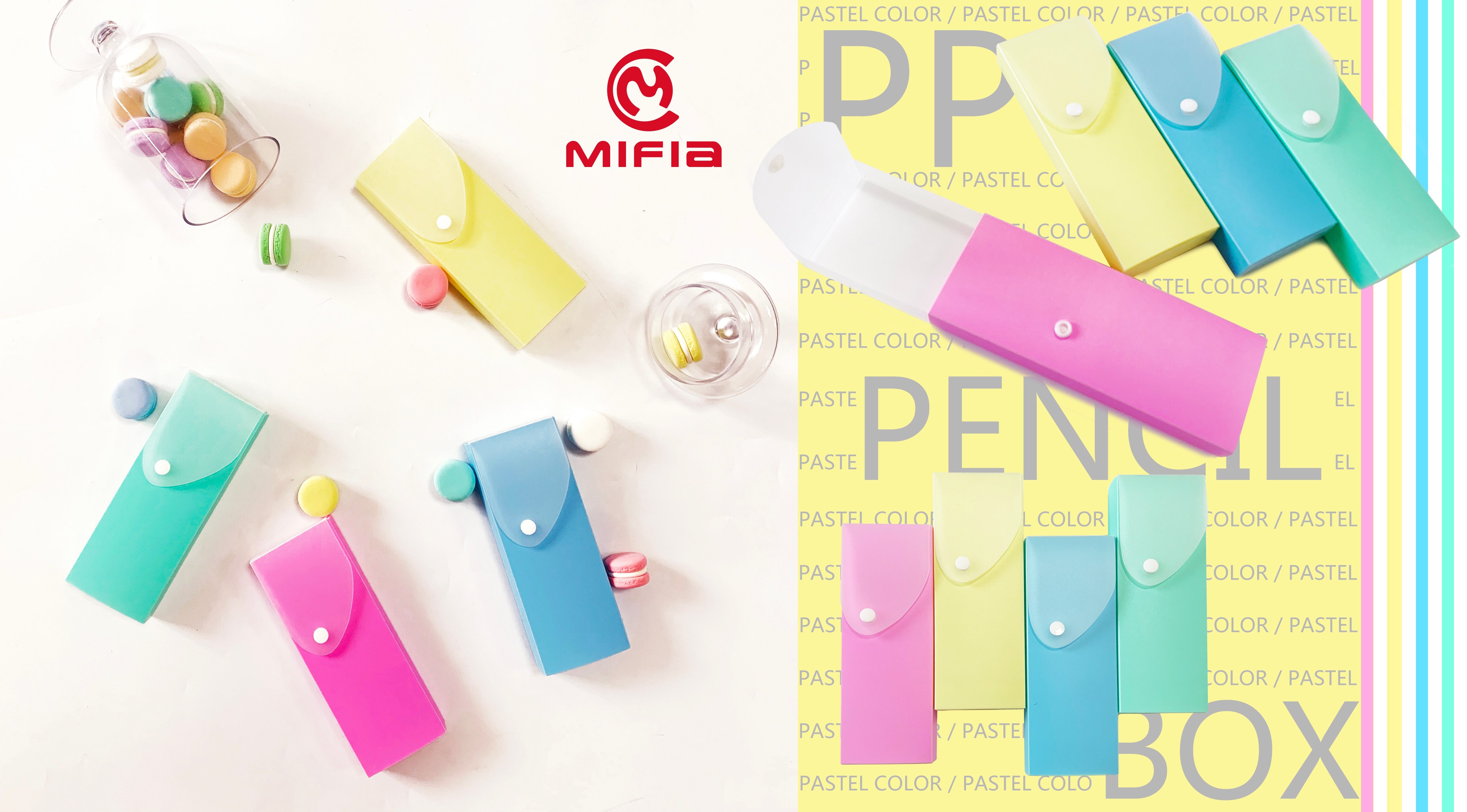
PP pencil boxes provide a more fixed shape.
Common formats include:
Snap-closure boxes | Drawer-style boxes | Transparent or translucent boxes | Solid-color boxes | Textured PP boxes
They are suitable when buyers need:
Shape retention
Easy-clean surfaces
Protection against pressure
Coordination with other PP stationery
Important checks include fold-line performance, closure alignment, drawer movement, stiffness and edge comfort.
Rectangular silicone pencil cases offer a soft surface and a clear three-dimensional form.
They are suitable for:
Trend-focused school ranges
Differentiated retail products
Soft-touch stationery collections
Medium-capacity storage
Standard or higher-value product positions
Compared with PP, silicone is softer and more flexible. Compared with EVA or PVC pouches, it normally offers a more distinctive shape and hand-feel.
Buyers should check product weight, silicone hardness,shape retention and deformation after packing.
Structure | Best For | Capacity | Market Position | Main Risk to Check |
Flat zipper case | Basic writing tools and school kits | Low to high | Entry-leveltomid-highrange | Insufficient height for items |
Gusseted pouch | Mixed stationery and markers | Medium | Mid-range | Excessive bulk or unstable loaded shape |
Round& Box-shaped case | Pens, pencils and youth ranges | Low to medium | Entry-level and mid-range | Narrow access and short-item retrieval |
PP pencil box | Structured protection and easy cleaning | Medium | Entry-level and mid-range | Closure alignment, fold lines and stiffness |
Silicone pencil case | Soft-touch and differentiated retail products | Medium | Mid-range to mid-high range | Weight, dust attraction and shape deformation |
This table should be used as an initial filter. The final structure should then be evaluated with the planned contents and expected daily use.
Material selection should follow the required product structure. Buyers should not select a material first and then force it into an unsuitable product format.
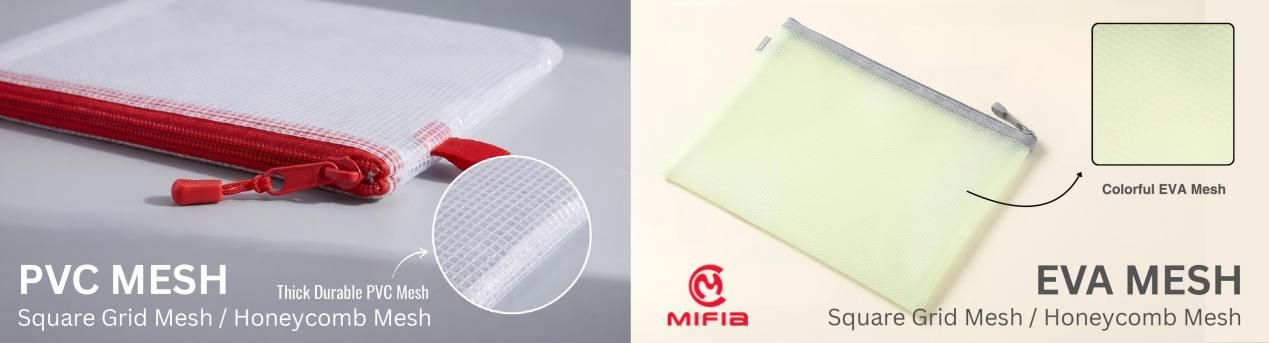
EVA is mainly suitable for flexible or semi-structured pencil pouches.
Advantages:
Flexible hand-feel,Soft-touch surface
Lightweight construction
Matte, glossy, translucent or solid effects
Suitable for mesh-textured products
Easy-clean surface
Common market position:
Mid-range to mid-high range retail
Office or home use
Color-coordinated stationery
Mesh pencil pouches
Products requiring a softer appearance
Points to check:
Tactile feeland thickness
Surface consistency
Shape after loading
Edge and zipper construction
Color performance
Common risks:
Product may be too soft in large sizes
Different thicknesses can change the hand-feel
Material water resistance should not be presented as complete product waterproofing, as zippers, seams, and stitching areas may still allow water ingress
PVC is commonly used when content visibility is important.
Advantages:
Clear or semi-transparent appearance
Easy content identification
Easy-clean surface
Suitable for plain or mesh-reinforced products
Strong visual presentation for retail or promotional programs
Common market position:
Entry-level and mid-range products | Transparent pencil pouches | Promotional products | Products where visibility is a key feature
Points to check:
Transparency
Surface marks
Flexibility
Smell requirements
Stitching or welding quality
Target-market compliance
Common risks:
Scratches and surface marks may be visible
Material softness varies by specification
Transparent surfaces can show untidy contents
Compliance requirements must be confirmed for the destination market,such as 6P, EN71-3, REACH and other applicable regulations
PP is suitable for structured pencil boxes.
Advantages:
Shape retention
Lightweight rigid or semi-rigid structure
Transparent, translucent or solid colors
Suitable for snap and drawer constructions
Easy-clean surface
Coordination with other PP school products
Common market position:
Entry-level and mid-range school retail
Practical school kits
Structured stationery collections
Points to check:
Thickness
Fold-line performance
Stiffness
Closure alignment
Drawer movement
Edge finish
Common risks:
Material that is too thin may deform
Material that is too stiff may affect folding or user comfort
Poor closure alignment can reduce usability
Silicone is suitable for soft, three-dimensional pencil cases,an experiential stationery product.
Advantages:
Soft-touch surface
Strong color presentation
Distinctive retail appearance
Flexible three-dimensional structure
Easy-clean surface
Common market position:
Mid-range to mid-high range retail
Trend-focused school programs
Lifestyle stationery collections
Differentiated products
Points to check:
Hardness
Product weight
Shape retention
Zipper performance
Surface finish
Packaging protection
Common risks:
Dust may attach to some surfaces
Products may feel too heavy if the wall is too thick
A product that is too soft may collapse during use
Material | Main Structure | Main Strength | Typical Position | Common Risk |
Eva | Flexible pouch | Soft appearance and lightweight use | Mid-range to mid-high range | Oversized, with poor shape retention |
CLORURO DE POLIVINILO | Clear or mesh pouch | Visibility and retail presentation | Entry-level and mid-range | Scratches and compliance requirements |
PÁGINAS | Structured box | Shape retention and practical protection | Entry-level and mid-range | Fold, stiffness or closure problems |
Silicone | 3D soft case | Touch and product differentiation | Mid-range to mid-high range | Weight, dust and deformation |
A product may have sufficient volume but still be inconvenient if users cannot reach the contents easily.
Check:
Opening width | Zipper movement | Movement around corners | End stops | Puller size | Performance under full load
Check:
Snap-button alignment | Opening force | Drawer movement | Edge comfort
Single-compartment products are suitable for simple school use.
Multiple compartments may be useful for:
Older students | Art tools | Larger stationery sets | Higher-value products
However, internal pockets, dividers and elastic loops should be checked with representative tools during sample review.
An unused pocket is not an additional benefit. It is only an added component and cost.
May use:
Bright colors | Simple graphics | Clear themes | Name-label areas | Easy-to-understand structures
May use:
Pastel or neutral colors | Simple branding | Transparent or translucent effects |More mature graphics | Structured formats
Customization may include:
School or brand colors | Logos | Graphic themes | Coordinated zippers | Labels | Printed packaging
School programs may prioritize:
Bulk packing
Product protection
Clear carton identification
Name labels
Packing within school-supply kits
Stationery stores and supermarkets may require:
Individual bags
Header cards
Hang tags
Printed inserts
Barcodes(ensure scannable)
Product dimensions
Clear material information
Structured PP and silicone products may need additional packaging protection to maintain their intended shape.
Selecting by external dimensions only
Ignoring ruler or marker length
Not reviewing the product under full-load conditions
Using vague terms such as medium or large without actual measurements
Selecting a small case for high-capacity contents
Adding too many pockets or elastic holders
Ignoring the opening width
Approving the closure only when the product is empty
1. Assuming thicker material is always better
2. Selecting a soft material for a product that needs strong shape retention
3. Treating a water-resistant surface as a fully waterproof product
4. Expecting different materials to show exactly the same color
5. Ignoring market-specific material requirements
1. Placing logos too close to seams, zippers or fold lines
2. Selecting design features before confirming the basic structure
Considering packaging only after the sample is approved
Increasing retail packaging volume without adding value
Failing to reserve space for barcodes and product information
A pencil case project should move through three clear confirmation stages.
Prepare a requirement sheet containing:
Target student age
Intended contents
Longest item
Required capacity
Product structure
Preferred material
Colors and graphics
Packaging method
Estimated quantity
Required market or compliance information
This document gives the manufacturer a clear basis for recommendations and quotation.
Evaluate the sample using the planned school-supply set and expected handling conditions.
Confirm:
Usable dimensions
Loaded capacity
Opening and closure
Internal organization
Shape after loading
Material hand-feel
Color and printing
Packaging protection
A sample should be reviewed as a working product, not only as a visual object.
Before bulk production, confirm the written specification, including:
FinalExternal dimensions
Material and thickness
Structure
Closure
Accessories
Colors
Artwork
Logo position
Packaging
Quantity per SKU
Approved sample reference
Any change after specification approval may affect price, samples, MOQ or production timing.
Before approving the pencil case, confirm:
Target student and sales channel
Actual contents
Longest and widest item
Usable internal dimensions
Required capacity
Selected structure
Selected material
Opening and closure
Internal compartments
Colors and graphics
Packaging
Estimated quantity
Approved sample
Final written specification
MIFIA supports the development of EVA and PVC pencil pouches, mesh pencil cases, PP pencil boxes and rectangular silicone pencil cases for importers, school-supply distributors, stationery brands and wholesale buyers.
Buyers can share the intended contents, required dimensions, preferred structure, estimated quantity and customization requirements. Based on this information, suitable material, construction and packaging options can be reviewed before sampling and quotation.
If you need professional, custom pencil case solutions for your stationery products, feel free to contáctanospara diseño personalizado y soporte de producción a granel.
There is no single size for every school program. The correct dimensions depend on the longest item, number of tools and selected structure.The standard DL size produced by manufacturers is 22 cm × 11 cm.
Compare the ruler with the usable internal length, not only the external case length. Zipper ends and rounded corners may reduce the available space.
One compartment is suitable for basic products. Multiple compartments may help organize larger sets, but they also reduce capacity and increase complexity.
A pencil pouch is generally softer and easier to compress. A pencil box provides greater shape retention and protection.
There is no single best material. EVA and PVC are suitable for flexible pouches, PP is suitable for structured boxes, and silicone is suitable for soft-touch three-dimensional products.
Yes, but the same color can appear different on EVA, PVC, PP and silicone. Actual material samples should be reviewed when close color coordination is required.
Define the student and contents first, confirm the usable size second, select the product structure
Aumente las ventas con acabados de superficie premium para artículos de papelería personalizados. Mejorar el atractivo en los lineales, construir marca
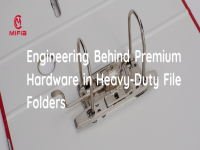
¿Busca carpetas de archivos confiables y resistentes? Combinamos ciencia de materiales avanzada con precisión ha
Escale su marca de papelería con MIFIA. Ofrecemos soluciones ODM/OEM flexibles, prototipos probados previamente,

Descubra cómo el sistema de control de calidad entre departamentos de MIFIA unifica los equipos de ventas, producción y diseño para lograr
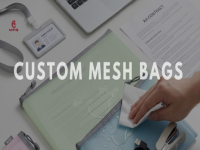
Cómo elegir bolsas de malla personalizadas para pedidos al por mayor (opciones de tamaño, material y diseño...
En el dinámico entorno empresarial actual, la organización eficaz ya no es una l...
Define the student and contents first, confirm the usable size second, select th...
Aumente las ventas con acabados de superficie premium para artículos de papelería personalizados. Mejorar el estante...
¿Busca carpetas de archivos confiables y resistentes? Combinamos ciencia de materiales avanzada...